There is a particular kind of founder who does not wait for permission. Dimitri Vargas Figueiredo Guimarães is that founder — and he has been that founder since he was fourteen years old. Born and bred in Espírito Santo, Brazil, Dimitri entered a science fair at his school in Vitória and won. The prize was two hundred reais. Most teenagers would have spent it on something forgettable. Dimitri bought his first personal computer.
What followed was not a slow awakening but an immediate, full-throttle immersion. With that machine, Dimitri began selling CDs to make money — burning, packaging, and distributing them around his neighborhood. He started offering IT technician services around town, making house calls to fix computers and set up networks. Before long, he had built his own network of more than thirty connected machines, and from that infrastructure he launched his first real company: InterPrime, which he later sold. He then started a web design company, sharpening his craft, before he created the venture that would define his career.
He walked into a digital multimedia agency in 2009, determined to understand how a software business actually runs. By the time he left, he had restructured the entire organization. In September 2011, still in his early twenties, he filed for a CNPJ in his own name and called the company ZERO-D. Over the course of fifteen years, it grew from a solo venture to a team of more than 150 professionals serving clients across Latin America and Europe.
“The people crazy enough to think they can change the world are the ones who do.”
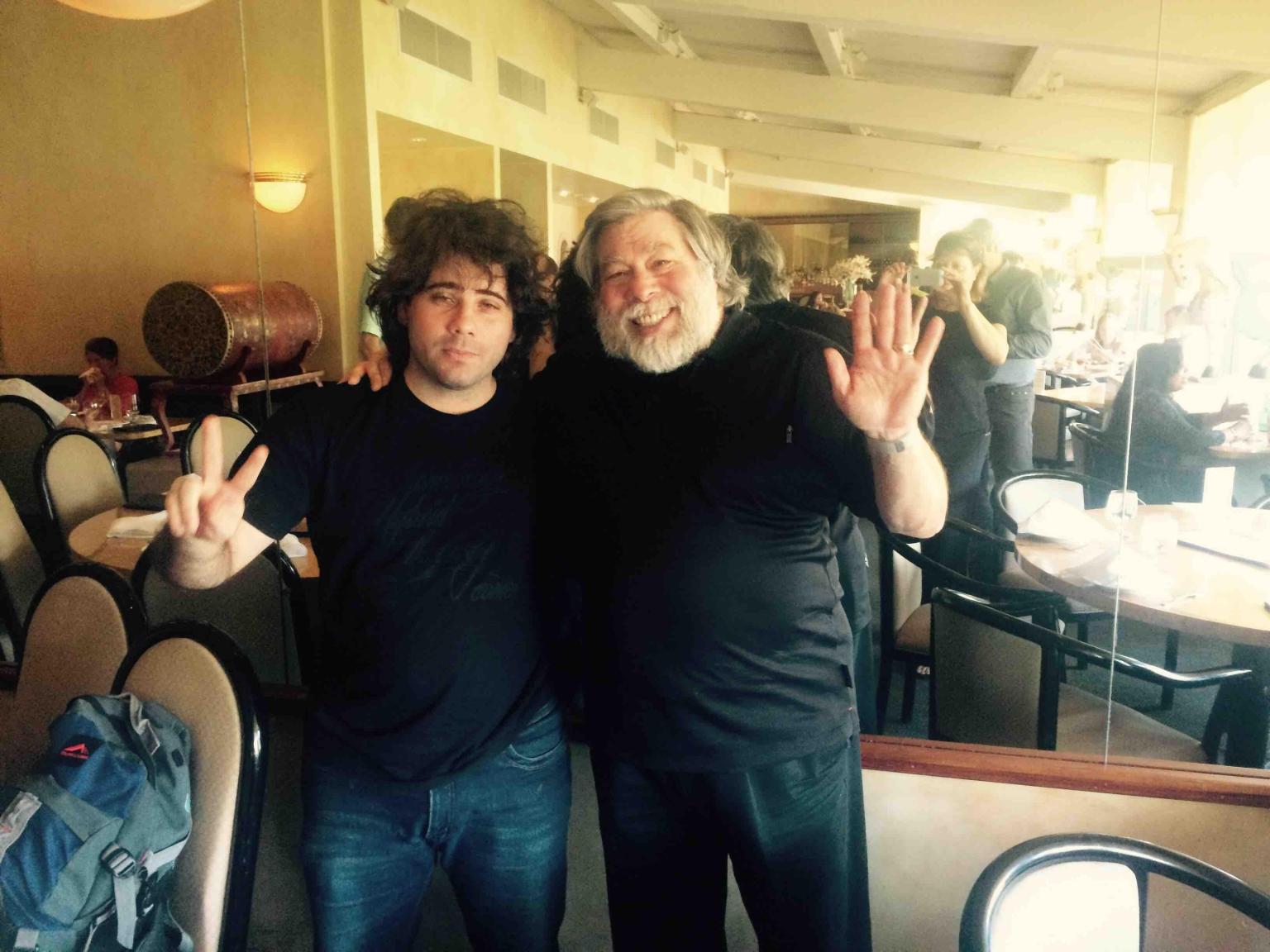
— Steve Jobs, quoted by Dimitri’s own colleagues in describing himThe photograph tells part of the story on its own: a beaming Dimitri, fingers held in a peace sign, standing beside Steve Wozniak — Apple co-founder, engineering legend, and one of the defining figures of the personal computing revolution. Dimitri did not stumble into that meeting. He flew to California with the express intention of being in rooms where history is made, attending networking breakfasts with entrepreneurs from across the globe, pitching his ideas to investors from Hong Kong, and absorbing the culture of Silicon Valley with the intensity of someone who intended to bring every lesson home.
“I was staying in a shared hostel,” he has recounted, “room two, three, six, ten, twelve — Brazilians, Chinese, Japanese, Indians, Mexicans, everyone sharing a space. I would have paid to sleep anywhere just to be part of those conversations.” He paid his own way. He used CalTrain to cross the Valley. He attended every event he could find on Booking, Uber, Meetup, Eventbrite, and LinkedIn. He learned enough Spanish to hold his own with entrepreneurs from across the Spanish-speaking world. And he came back to Vila Velha — not humbled, but ignited.
“I was staying in a shared hostel with people from every corner of the world. I would have paid to sleep anywhere just to be part of those conversations.”
— Dimitri VargasWhat ZERO-D Actually Builds
To understand ZERO-D is to understand Dimitri’s philosophy: that software is not a product category, it is a medium. The company builds CRMs, ERPs, SaaS platforms, mobile applications, point-of-sale systems, geological monitoring platforms, real estate portals, health management systems, and nearly anything else that a modern business might need to run its digital operations. The portfolio spans more than fifty industries — from offshore oil and gas to e-sports, from telemedicine to agricultural monitoring.
What distinguishes ZERO-D is not the breadth of its catalog but the depth of its commitment to custom work. In a market increasingly dominated by off-the-shelf SaaS and template-driven agencies, Dimitri built a company that still asks “what do you actually need?” before it writes a single line. The result is a portfolio of genuinely complex, genuinely differentiated software — a geological platform that tracks oil well data in real time, a health-plan CRM with integrated payment processing, a metrological inspection application with offline-sync capabilities. These are not websites. These are operating systems for businesses.
Today, ZERO-D has expanded beyond Brazil’s borders. The company serves clients in Spain, Portugal, and Ireland, with plans for deeper European integration. Its website operates in Portuguese and English. Its team is multilingual. And its founder — who once slept in a bunk bed in San José to save money for one more networking event — now sits at the helm of an organization he describes as being on course to become one of Latin America’s most important technology companies by 2028.
The Mind Behind the Machine
Those who have worked alongside Dimitri reach for the same vocabulary: relentless, joyful, sharp, responsible. “His ability to handle responsibility with a mix of humor and intelligence sets him apart,” wrote one former colleague. Another: “He is not only highly skilled — he brings a sense of joy and camaraderie to the work environment.” A third invoked Steve Jobs directly, quoting the “Here’s to the crazy ones” manifesto as the only adequate description.
What those testimonials point toward is a leader who has never separated his personal curiosity from his professional drive. Dimitri’s notebooks — one imagines many of them, digital and physical — contain not just project specs but ideas about the future of work, the democratization of technology, the role that small companies from non-obvious geographies can play in reshaping global business. He has written publicly about the “end of large corporations” as gatekeepers, about the rise of fintech and maker culture, about the capacity of small artisanal workshops equipped with 3D printers to compete with industrial giants.
These are not abstract musings. They are the philosophical scaffolding of a founder who built his company precisely to prove that thesis — that you do not need to be in São Paulo, or San Francisco, or Berlin to build world-class software. You need talent, discipline, and the refusal to accept that geography is destiny.
“His intelligence, his quick problem-solving skills, and his genuine friendliness make him not just a colleague but a true friend to everyone.”
— Former colleague, LinkedIn recommendationThe vision Dimitri has articulated for ZERO-D is clear-eyed and ambitious without being naive. The company intends to be a reference point for digital business creation in Latin America, with a consolidated European presence, by 2028. The strategic levers are already engaged: internationalization, multilingual support, compliance with European technical and legal standards, and a deliberate focus on sectors — health, energy, finance, logistics — where bespoke software commands real prices and long relationships.
The next chapter is already taking physical and financial shape. ZERO-D is currently in negotiations to raise more than R$10 million, with talks progressing with several venture capital firms in Brazil. It would be the company’s first institutional round — a milestone that, for a bootstrapped operation out of Vila Velha, carries symbolic weight far beyond the balance sheet. Simultaneously, the company is constructing a new purpose-built headquarters, a striking modern structure designed to house its growing team and signal permanence in a region that rarely produces technology companies of this scale.
He is also, characteristically, thinking about the ecosystem beyond his own company. As someone who navigated the Brazilian entrepreneurial landscape before there were playbooks for it, Dimitri has become an informal mentor and visible voice for the next generation of founders in Espírito Santo and beyond. His appearances at events like Rede Petros are not merely promotional; they are the actions of someone who believes that the tide of Brazilian technology is rising and wants to help lift every boat in it.
The picture with Steve Wozniak hangs in the memory as a symbol of something beyond mere celebrity proximity. It is a picture of a founder who traveled thousands of miles on his own dime to stand in the same room as his heroes — and who then came home and built something worth traveling to see. Fifteen years in, with five hundred projects delivered, one hundred fifty professionals on the team, a perfect five-star rating from his clients, a ten-million-real fundraise on the table, and a new headquarters rising from the ground, Dimitri Vargas Figueiredo Guimarães has not finished proving anything. He is, by every available measure, just getting started.